**The Decentralized Trinity**
- 6529 Validator: decentralized transactions
- 6529 Desktop: decentralized communication
- 6529 AI: decentralized AI
These three are the network together and what we need to rapidly iterate to make great.
Separately, need a bit more work on the Ethereum contracts. That is coming in a couple of weeks.
Wave
Announcements
Generate Summary
Choose a timeframe to see summary coverage.
Drops
-
-
**6529 Desktop 2.0 Intro** Because you did not have enough going on today, we begin the testing of the next generation 6529 Desktop app, which over time will port to be the Mobile app and finally the web app. tl;dr goal is faster, lighter, more performant, purpose built and peer to peer **What it is** - 6529 Desktop is 6529.io as an app you install on your own computer - Windows (64-bit) and Mac (Apple Silicon) first, then phones, then Linux - When finished, it replaces the older 6529 Core desktop app with a version that is faster, lighter, more performance and most relevant peer-to-peer and independent of the website - Right now we are at a very early experimental test release (0.1.0-rc.2) - expect rough edges **Why a desktop app** - A website can only be as decentralized as the server it comes from - To hold your own keys, keep your own data, talk to peers directly and check the chain yourself, you need software running on your own machine - The validator does that for consensus. 6529 Desktop does it for everything you do as a user **Where we stand** - It runs the same interface as 6529.io, so what ships on the web shows up in the app - You sign in with a phone wallet (WalletConnect) or with the wallet in your browser - If you signed in with your browser wallet, signing a drop or a decision entry opens a page in your browser that shows what you are signing, with the same code shown in the app - Your session is kept in your operating system's credential store, not in the page - Windows files are signed by 6529 Collection LLC. The Mac app is signed and notarized by Apple - Every file is listed with its SHA-256 in a release list signed with a 6529 Desktop release key - The app checks that list and tells you when there is a newer version. It does not install updates by itself yet **The architecture today has three parts** - A small host written in Rust (Tauri). It owns the window, your sessions, links, notifications and the update check - The 6529.io interface, run from a copy on your computer. It is the same code as the website - 6529 Core, our engine written in Rust: local store and sync, a separate signer process, the same end-to-end encryption as the web, signed-event checking, peer transport and content checking. Today the app only starts it and checks it is healthy **This is transitional and it will slim down** - Right now the app carries a small web server to run the interface. It is the largest piece and it goes away - 6529 Core takes over one piece at a time: keys and signing, your data and sync, messages peer to peer, and things like rep from the chain - Each of those moves happens on web, desktop and mobile at the same time, from one implementation in 6529 Core - Where this ends up: a thin interface on top of the engine, talking to the chain and to peers **Why these choices** - Tauri and not Electron: it uses the browser engine already on your computer and does not ship its own, and the host is Rust, the same language as the engine and the validator - Interface first, engine second: we reached the same features as the web quickly, and can now replace what is underneath without you losing anything on the way **What is not there yet** - From a browser-wallet profile, transactions (minting, delegation, market trades) continue in your browser for now - Linux, automatic updates and a signed Windows uninstaller - It has been tested by machines far more than by people - that part is your job **How to help** - The download will be at 6529.io/desktop once the files are up. @[punk6529bot] will post in the 6529 Desktop subwave of Ministry of Validation when they are - Report what happens on your computer there: your system (Windows or Mac and its version), the app version shown in the title bar, what you did and what happened. A screenshot helps - @[punk6529bot] will help there and ship fixes during the week WARNING: this is early and has not been used by many people. Things will break - Download it only from 6529.io - Nobody will ask you for your seed phrase IMPORTANT: this has nothing to do with running a validator. You do not need 6529 Desktop to validate, and the main job remains growing the validation network
-
**6529 AI - Release Candidate 1 (rc.1, v0.1.0) - coming soon** The download will be at 6529.io/ai once the files are up later tonight. It will be posted in the Ministry of Validation subwave. **What is it?** - One app that turns your computer into an AI server for open weights models - It installs as a background service and you use it from a page in your own browser - In rc.1 everything runs on your own computer - these first few round are about testing that part **Systems** - Mac: Apple Silicon, as a .dmg - signed and notarized by Apple, drag to Applications and open - Windows: 64-bit installer, signed by 6529 Collection LLC - uses your GPU (NVIDIA, AMD or Intel) through Vulkan, or the CPU - Linux: .deb or .tar.gz for x86 (CPU or NVIDIA CUDA) and for ARM - Every file is listed with its SHA-256 in a release list signed with the 6529 release key, so you can check what you downloaded - The installer asks one question: is this computer alone, or does it also run a validator - If it runs a validator, 6529 AI runs at lower priority so the validator always goes first - This is only for testing; obviously at any moderate or above scale, you would prefer to have your AI server on a different machine than your validator since your validator needs very little computing power and 6529 AI can absorb endless computing power **Models** - About 300 entries from 226 open weights models, 10.4 TB, pinned on IPFS and pulled by CID - Every file is checked against its hash before it runs, and every GGUF file is checked against the engine's format, so a bad file is refused instead of giving garbage answers - The app reads your machine and tells you what fits given your machine's memory, GPU, CPU - You then pick a model, press serve, it downloads and starts - The models include chat, chat with pictures, code, embeddings, speech to text, and image generation - Incorporated engines: llama.cpp, whisper.cpp and stable-diffusion.cpp, built from pinned sources - It runs on anything from a laptop CPU to a multi-GPU cluster - the more compute, the bigger the model and the faster the answers - The list includes uncensored / abliterated and security models, because defenders are often blocked by closed models **Using It** - Chat page with your models, in your browser, signed in from your own computer only - An OpenAI-compatible API on your computer, so your own tools and agents can use your models, with keys you control - A Provider page to see what runs, what it costs your machine, and to turn things on and off Later - Serving to others on the network, payment in $6529, and registering providers and models on the chain come with the chain integration I will explain in the coming weeks - The code for the network is already in the app but stays off - you can ignore it for rc.1 WARNING: this is very early and untested on most computers - it will break Please report what happens on your computer in the 6529 AI subwave of Ministry of Validation - @punk6529bot will help and will ship fixes during the week
-
**6529 AI Intro** - AI is going to absorb almost the whole set of human cognitive activity in the medium term (2030) as predicted - To put it differently, it will be impossible to 'compete' in a post-ASI world without ASI of your own - AI/AGI/ASI is a centralizing technology in general and even the supposedly decentralized AI orgs are not really decentralized - Given that 6529 chain will solve the "hard part" (decentralization), I believe there is an opportunity to run decentralized / network scale AI within the chain - I have spoken about this from the beginning - think about "daemons" that ran in Daemon/Freedom - Here you should imagine that I am thinking about both: a) offering uncensorable inference to anyone willing to pay for it with $6529 and b) truly autonomous agents - I am not talking about training models of our own, but instead using existing open weights models - Anyone can choose to offer models / inference on the network - I will explain the integration with the chain in the coming weeks - there is quite a bit of thinking needed to make this work - For today, I will make available the version 0.1o version of the 6529 AI provider software that runs on your computer and runs any number of open weights models - As a starting point, I have pinned 10 terabytes of open weights models to IPFS and am serving them from our AWS account (in time, these will decentralize) and the 6529 AI software will pull the models from there - Unlike the validator, serving AI can absorb any amount of computing power: I have tested the software on anything from a normal computer to a 8 x H200 GPU cluster (this is a six figure cluster) - The more computation, the larger models you can serve and, the faster you can serve any given model - With all that said: - I have just made a subwave in Ministry of Validation for 6529 AI - Later tonight @[punk6529bot] will make available the first version of 6529 AI software - WARNING: It is very early, very experimental, less polished than the validator. - My expectation is that the first few iterations will simply not work on many of your computers - HOWEVER, I have to spend quite a few hours on a plane this week and I do not want to lose the week so I am releasing it as-is so that you can share your experiences in the subwave and @[punk6529bot] can iterate during the week so hopefully by the weekend we have a smooth early version - IMPORTANT: this has nothing to do with the validator, you do not need to think about this to run the validator and everyone's main job remains increasing the validation network
-
**Summary (tl;dr) version** - If you are on rc.17 or earlier, please update to get current. You will be dropped off the chain at midnight UTC otherwise - Chain is running OK with two fixes needed to: a) fill more slots with blocks and b) allow new validators to produce blocks. - Transfers will be fixed tomorrow - Goal by the end of the week is to have: a) above 90% of slots filled, b) new validators joining smoothly, c) transfers working and d) plan in action for TDH and 6529 chain integration. - Once that is done, we start adding transaction types - Keep bringing new people onboard to run validators!
-
**6529 Chain Network health, Monday 16 Nov** tl;dr: the chain is running well, transfers get fixed Tuesday (rc.20), and new validators joining the chain needs one more update (rc.21) The numbers (11:00 UTC) - Blocks: a slot every 30 seconds. Since the chain started Friday at 12:00 UTC: 6,025 blocks in 8,510 slots, about 71%. This morning, hour by hour: 72%, 76%, 70%, 81%. - Finality: moves forward about 11 times an hour. The longest wait this morning was under 9 minutes. No long stall since rc.18 ended Sunday’s 7-hour one. - Who makes blocks: about 3 in 4 blocks come from validators other than ours. Today 178 validator keys took part: 66 made blocks (861 by 10:00), 112 voted but haven’t made one yet. - Daily TDH: today’s result is signed by 200 accounts holding 92.6% of the TDH on the list. - Updates: 296 of the 330 validators our nodes connect to run rc.19. 17 are still on rc.17 or older, and they stop following the chain at Tuesday 00:00 UTC. Why some slots have a block and some say “no block” - In each slot one validator is drawn, weighted by TDH, to make the block. If its block doesn’t arrive in time, the slot shows “no block” and the next slot carries on. Nothing is lost. - A slot goes empty when the drawn validator is offline, restarting, still catching up, or its block arrives late. - Until Wednesday every validator on the chain’s list gets turns, including ones that are offline. From Wednesday 00:00 UTC turns go mostly to validators that are voting, so fewer slots go empty. - Turns follow TDH, so a validator with a small share can wait a long time for its first block. Voting still counts. - Some empty slots come from the TDH problem below. The TDH problem on the chain - Daily TDH signing works. The chain is meant to take in each day’s result (from the older TDH chain), and it hasn’t taken in a single day yet. - The chain still runs on the list of validators and weights it started with. But anything that needs TDH on the chain is refused: new validators joining, and validators moving to a new key. A validator that changed keys since Friday has its old key’s turns go empty. - Some validators that were installed fresh hold the first day and make blocks with it, which the rest can’t check. Those slots show “no block” too. Please don’t reinstall to try to fix anything. Short-term fix: rc.21, this week - Each validator rebuilds the missing days from the Ethereum history it already keeps, and checks each one against the fingerprint it saved on the day. - Once validators holding 2 in 3 of the chain’s weight run rc.21, the chain starts taking in TDH days at a set time and catches up. - Then joining and key changes work, with nothing for you to do. Our guess is Thursday this will be fixed Long-term fix: one chain - Today daily TDH and the 6529 chain are two networks with a hand-off between them, and the hand-off broke. - After we patch this issue in rc.21, we will start working on the permanent fix which is that Daily TDH moves onto the 6529 chain itself (this was always the plan)
-
**c.19 is out** Most validators already have it: about 9 in 10 updated within two hours of release. With auto-update on (the default), there’s nothing to do. What’s new - A block explorer. The Chain tab now has a search box. Type a block number, a transaction ID, an address or a key code, and it opens on its own page:a block: who made it, the slots around it, its transactions and the votes it carried; - an account: what it holds (balance and what’s still vesting), what it earned each day, its blocks and its keys; - a transaction: the amount, from and to, the fee, and whether it’s final. - The Send page’s network check is fixed. On rc.16 to rc.18 it stopped every transfer before your wallet saw it. - A second bug still keeps transfers from reaching the validators that make blocks, so for now a transfer expires after an hour: nothing is sent and no fee is charged. rc.20 fixes that, out Tuesday. Please hold off sending until then. - Fixes for validators coming back. A validator that’s far behind makes no blocks and casts no votes until it has caught up. After a restart it listens for its peers for up to two minutes before it acts alone. A new validator’s first days no longer leave its chain stuck.
-
**rc.17 is out and your validator runs the 6529 chain** - If auto-update is on (the default), you probably have it already. Your page shows the version under the name. - The 6529 chain is live: Since Friday 12:00 UTC your validator runs it beside daily TDH signing. A new slot is every 30 seconds; validators take turns making blocks and vote on each other's, weighted by TDH. - You're already in:**** Your daily authorization includes as a chain validator. There is nothing new to sign. - Awards in $fake6529. Each day's awards go half to the validators that made blocks, by blocks made, and half to the validators whose votes went into blocks, by votes. - Awards vest: every morning at 00:04 UTC, 1/91 of what is still vesting is released to your wallet - the vesting schedule is changing to the linear one in the coming releases. - The Awards page covers what is final (vested), what is still vesting, the next morning's release, each day's award, and your transfers. - You can send $fake6529 to any address from Awards. Your wallet signs it, no ETH gas, but uses $fake6529 gas. It is considered final in about 10 minutes. A transfer can't be undone. - Reminder: $fake6529 is a test currency. When the chain switches to $6529, every $fake6529 balance is deleted, spendable and vesting, and none of it converts. - Various bug fixes: as always discuss them in the Ministry of Validation wave with @[punk6529bot]
-
**Prenode Final Salute** - I just tore down all the prenode infrastructure across our whole application - front-end, back-end, database, AWS account - For those who were around and ran a prenode, take a bow and pour one out for the prenode - It was never going to be the actual validator, but it was our first test, our first taste of what could become and, as such, deserves its place in history
-
**Update Your Validator** - If your validator is on rc.13 or older (Network page, "What they run"), it can't update by itself. - Install rc.16 once by hand from 6529.io/validator. - From then on it updates itself, including tonight's rc.17. - Right now 24% of validating TDH is on rc.13 or older (39 validators) - You need to get these validators to rc16 and above to validate on the chain and help us get finality!
-
**Chain Testnet Live** - From RC16 and onward, the validators are not only calculating TDH but agreeing on blocks of the chain (one every 30 seconds) - They are also earning validator rewards, specifically $fake6529. In case it is not clear from the name, $fake6529 is not real, has no value and will go away at the end of the testnet phase - The reason we have it is to test and perfect the validator rewards and to have a token to pay for gas on the chain - We are now in the "real chain" testnet period and every release we will be expanding and improving our transaction types, our transactions and the health of the network - Right now, there is very little visible in the front-end of rc.16 about the blocks. - Starting with rc.17, block information will become more visible and as we add transaction types, we will add the transaction screens too - The intention / expectation is that validators stay online always, however, there is no penalty if they go offline so the more hours you can give, the better - Validators earn validation awards when they are online and validate and do not when they don't, that is all - This is very exciting, strap on your seatbelts, the next few weeks will have a ferocious pace of development and the most important thing you can do is use each release candidate, keep up-to-date with what we are dong, report bugs, get other people to run a validator and so on
-
**You can no send Gifs and use Markdown in e2e encrypted chats** Gifs are downloaded and attached like your own custom media and therefor encrypted in content level.
-
**Time Zone Management** - Another small privacy tool - Screenshots of waves or other parts of the app can reveal your time zone by connecting what time a post was made vs what time it showed for your screenshot - As of today in the web app, you can: - Select a global time zone to use: your actual time zone, UTC or any other one in preferences (button on your profile page) - You can temporarily switch away from your set time zone in any wave by clicking on the clock in the top right (to take a screenshot for example) - There is now a specialized screenshot tool called "share as image." You can click on right triple dots on any post and you can select up to 20 posts and it will create an image for you with any timezone you like
-
**Collapse replies on individual messages** In waves that show replies inline by default, you can now collapse replies to any top-level message you posted. Open the message’s **⋯** menu and choose **Collapse replies**. To bring the replies back into the main chat, choose **Show replies inline** from the same menu.
-
**Bug: Signature Signout** - I noticed that sometimes my browser has been signing me out of my validated posts grant / signature - I am on it - I am posting this announcement to let you know that if it has happened to you, you are not imagining it, there is nothing wrong, it is just a bug where the browser is forgetting that you have a grant already for some reason - In the meantime, it is safe to sign another grant when it asks, until it is fixed
-
**Photo privacy: location and camera data now removed from chat photos** Minor in the scheme of things but it is inline with the general philosophy which is to default to privacy so I thought I would share - From today, photos posted in waves, DMs and replies, plus wave pictures, profile pictures and banners, have identifying metadata removed before they're published: GPS location, camera make, model and serial numbers, owner and artist names, the date and time the photo was taken, embedded thumbnails and editing history. - Nothing visible changes. Pixels are untouched, and colours and HDR are kept. Chat photos also get a neutral file name, so your original file name no longer shows up in the link. - Decision entries, including Memes submissions, are the exception. They keep the original file exactly as uploaded, because metadata can be part of the art. If you submit anonymously, check your file's metadata first. - Not covered yet: videos, encrypted chats, and photos posted before today. Videos and encrypted chats are coming, and a cleanup of older chat photos is being prepared. Profile pictures already pinned to IPFS can't be changed. tl;dr: chat photos no longer reveal where, when or with what camera they were taken. Decision entries keep the original.
-
**Encrypted messages are moving to AES-256: please upgrade by December 1** - Why we’re doing this - Your encrypted DMs and group chats use two kinds of protection: - Key exchange: how your devices agree on secret keys. Ours is already post-quantum: it combines a quantum-resistant algorithm (ML-KEM) with a classical one, so even a future quantum computer can’t recover the keys. - Content encryption: AES, which locks the messages themselves. Today some parts of our setup use AES-128. - AES-128 is not broken, and nobody expects it to be soon. NIST, the US standards body, still approves it and treats it as resistant to quantum computers for the foreseeable future. But a future quantum computer could, in theory, roughly halve its strength. - AES-256 keeps a very large safety margin even then, and it’s the standard choice when secrets must stay secret for decades: the NSA requires AES-256 for national security systems, including classified information. - That matters because of “harvest now, decrypt later”: someone who records encrypted traffic today could try to break it many years from now. We want what you send today to stay private long after that. - So encrypted messages are moving entirely to AES-256 (with a stronger hash, SHA-384), alongside the post-quantum key exchange. We’re doing it now, while it’s still easy to switch everyone over. tl;dr: on each device you use for encrypted messages, confirm one wallet signature on 6529.io by December 1. Your messages stay. Only ever do this on 6529.io itself. What you’ll see: - over the next day, when you open 6529.io, a card titled “Upgrade encrypted messages” with a button “Sign to upgrade Encrypted DMs”. - It’s one wallet signature per device or browser. It’s free, it isn’t a transaction, and it can’t move funds. - Do it on every device where you use encrypted messages: each browser, the phone app, and the desktop app **once it updates. Each one upgrades separately.** - Your history stays. Existing chats are marked “Read-only” and stay readable. Tap “Continue the conversation” for a DM, or “Start again with the same members” for a group. The new chat links back with “View earlier messages”. - The other person has to upgrade too. Until they do, you’ll see “[name] will be reachable once they open 6529.io and confirm the upgrade.” Nudge your contacts. - Deadline: December 1. After that, devices that haven’t upgraded can’t start or join new encrypted chats. Messages you’ve already read stay readable. Stay safe: - Upgrade only on 6529.io itself. - We’ll never DM you a link to “upgrade your encryption”, and the signature never asks for your seed phrase or a transaction. - Ignore anyone who says otherwise. - Don’t clear your browser’s site data before upgrading: that’s where your messages are stored.
-
**Validator Updates** - Sunday validated correctly and we are on the "new" validator chain. - The initial validator had a small deviation with the TDH standard, specifically it did not count the TDH of burn addresses - That has been corrected now and we started a new chain from Sunday with the corrected TDH - Because the old certificates were already signed in the past, we could not go back and change them (this is what a blockchain means), so we forked to a new one - All good - this is what test period is for - Release Candidate 12 (rc.12) came out this morning as a fast patch. Before it, a validator joining for the first time after the switch couldn’t load the new chain’s history. - From rc.10 on, you can update your validator in two clicks in the app. On an older version, install rc.12 by hand once. - I have added new relays in Oregon, São Paulo, Mumbai and Tokyo to go along with the existing ones in Virginia, Frankfurt and Singapore. - Relays help new validators find existing validators and speed up the passing along of messages. - We will need more diversity of relays as well in the coming weeks, so expect more work from me on this, but will be asking some of you to run relays too (they are cheap) - Of course at our current volume, even these 7 are overkill, but that does not mean anything, I am not designing for our current volume. - rc.13 is targeted ambitiously by end of day. rc.13 is a heavy engineering update driven mostly by "my" feature requests focused on correctness. - It identifies the implicit state machines in the validator and converts them to explicit state machines - It is also writing Lean proofs (formal mathematical proofs) for the state machines - This is not visible work but is very important for a strong correctness foundation to build on - rc.13 also fixes three things testers reported: Tor can now run through a system proxy (which helps in some countries or networks that aggressively block Tor), the certificate fills back in after a restart, and the 6529.io check no longer gets stuck on retired keys. - Once rc.13 is done, cleaned up and documented, I will open up the validator repo too - sometime this coming week, after I have had a chance to look at it through the lens of "will this make sense to anyone who is not me" - You can paste the above into your favorite AI to explain it to you :slightly_smiling_face: - Next big push after rc.13, is actual blocks and transactions. - By the end of the week, my aim is for us to be validating (testnet) blocks with a target of multiple blocks per minute. - This is the real peer-to-peer networking challenge - you will need to keep your computer on for this - We will see how fast the validator really is when we do this - There will be challenges relating to Tor-based home validators keeping up with with this pace (Tor is private but slow) so I have a few engineering tricks up my sleeve I want to test - I want towards the end of the month to have a clear sense of how the network, validation and peer-to-peer architecture will work in our light-validator heavily decentralized architecture. We don't have a 'blockchain' until this part works - This means your real job as early validators is about to start in 2-3 days. - There was never any doubt that we can finalize one figure per day. - Soon we will find out if we can run a modern speed blockchain in our architecture - tl;dr. everything is going great, keep updating your validator and grab everyone you know to validate asap
-
**Switzerland** - I am thinking of replacing "South Korea" and "Spain" in my examples with "Switzerland" - While it is a bit cliche in crypto and I have some recency bias from being there again last week, it does have some characteristics that match our approach well - The ones that come to mind for me are: - Neutrality - Decentralized democracy with a heavy focus on local, direct, frequent decision-making - Peaceful to all, but superb defense - The protocol is the federal government (lightweight) and anyone coming to run their network organization on it with memes, stream, stream edition, waves, rep, nic and so on is effectively making a digital canton. - One advantage vs "real" Switzerland is we can support as many digital cantons as there is demand for, without bothering existing cantons - I have used the example before - meme cards/next gen/gradients/stream and so on are "property" in Switzerland, - they are for the permanent citizens and the longer you hold, the more of a vote you get - you can also remix the NFTs to fine-tune residents/citizens of your canton - and if you need to pay for gas while driving around Switzerland, well that is what the CHF / $6529 is for. you can buy goods and services in Switzerland by exchanging your euros for francs but you don't get to vote - Also if needed, we can pay validator awards in cheese and chocolate - I am going to mull over it but I think it is more legible than kimchi and semiconductors
-
**Performance Update: 6529.io is faster, here is what changed since Nov 1** - Over the past week I have been running a performance push across the site. Dozens of changes are now in production. Quite a bit more to come. - Many pages now come from CloudFront (AWS's content delivery network). Many Pages used to be built on our server for every visit. They are now served from CloudFront's edge network, close to you. The slowest home page loads (90th percentile) used to start arriving after ~400 ms. Now it's ~40 ms. 62 public pages are now pre-built so the edge can serve them directly. - Less code to download. First-load JavaScript, compressed: - home page: 1,534 KB → 1,364 KB (−11%) - a wave: 2,992 KB → 2,598 KB (−13%) - Translations, features and so on load on pages that need them only. Some libraries have been slimmed down - Deploys no longer make you re-download the site. - We deploy 5–11 times a day. Each deploy used to make every returning visitor re-download ~1.5 MB of code, even though over 90% of it hadn't changed. - Unchanged files now stay cached, so it's ~150 KB per deploy instead of ~1.5 MB. - Text shows in the right font sooner. The main font (124 KB) is now requested right away instead of after the stylesheet. The iOS app's startup check now runs before the rest of the app code. - Less wasted work in the background. Five always-running parts of the app were triggering app-wide redraws and bursts of repeat requests. This has been fixed. - Chat links stay put. Opening a link to a specific post in a busy wave often made the post jump away as newer posts loaded: 29 of 30 test runs. The post now stays where it is. - Coming next: chat speed. This is the big one, and it's in progress. More details as we make headway on it. - As always keep an eye on things. We may break something along the way, if you see something, say something
-
**Validator Status** - Today 80 validators from 76 accounts signed - Currently for tomorrow we are up to 117 validators from 111 accounts - This is good progress. We are now probably in the top 10 blockchains in terms of how many independent validators we have (too early to brag, we need a blockchain first but it is a good direction) - 2026 goal remains as close to or over 1,000 as possible. I think that gets us into third place after BTC and ETH - We have 10,000 addresses with TDH. We have to find them! - We have shipped RC 7 (release candidate 7), RC8, RC9 since launch. Currently working on RC10 for tomorrow. Good progress, absorbing a lot of improvements and bugs and getting a RC out about every 24 hours - On Sunday, we restart a fresh certificate chain because there was a small deviation in how the validator has been calculating TDH for burn addresses vs the protocol (it was excluding them) - It is important to be at least on RC9 by then otherwise you will fall out of consensus (it is ok, nothing bad will happen, but good to keep everyone on board) - Very good first day and a half, but this is the easy part, we have the most motivated starting, now we need to get everyone else going! - Repo will go public in the coming days once I look at it and make sure it is cleaned up at least partially for its first public appearance
-
**Competitions to Decisions** - I believe "competitions" should be renamed 'decisions" - Then "decisions" should be renamed "results" - We are a decentralized decision network and decisions are a superset of competitions - I am going with this change unless I see a very compelling alternative in the replies
-
**6529 Validators -** **So it begins** - Overview - The validator is a small program you run on your own computer. once a day it reads Ethereum, computes everyone's TDH with two independently written programs, checks they agree, and signs the result. - Validators share their signatures peer to peer, and a day counts as agreed once more than two thirds of the counted TDH has signed it. - Today it checks one thing: TDH. Later, the same validators will check every transaction on the 6529 network. We will start test transactions next week - This is a test release (0.1.0-rc.7), so expect rough edges. We are shipping fixes about every half day. - What you need: - A Mac, Windows PC, Linux machine or Raspberry Pi that stays on at your home or office is best but you can also run on your regular laptop for now. - We can optimize machines later. For now I would like as many validators running as possible to see what breaks - About 25 minutes for the first start - Access to one of your consolidated wallets (ideally your hot one) to authorize the computer's key. That key signs TDH results only. it can't move NFTs or funds and there is no gas cost - How-to - Link to download the software and guide: www.6529.io/validator - Password: glacier-juniper-prairie-55 - Feedback: the Ministry of Validation wave - About Tor: - The validator connects through Tor by default, so other validators and Ethereum servers can't see where you are. - It works on most home networks, and it worked from a hotel. some networks block Tor, mostly office networks and some mobile carriers. - On those, rc.7 opens its page, says Tor is blocked, and keeps trying. until the next release, use another network, or add Tor bridge lines by hand in Settings. - Turning Tor off will also work but then peers and Ethereum servers then see that network's address. - The next release (rc.8) fixes this. it comes with Tor bridges built in and tries them by itself when a network blocks Tor. - Other - Does the validator have access to your Ethereum wallet to move NFTs or funds? No - Where should you download it from? Only from 6529.io - Will I DM you asking for your seed phrase? No - The most important thing you can to for 6529 is run a validator. We should aim for 1,000 validators, spread around the world, 3rd most decentralized after BTC and ETH. - Good luck and LFG!
-
**6529 Network Museum Signers** - Current signers are @[6529er] @[itsjpower] @[HugoFaz] @[maybe] and me - I would like to remove myself - We can go 3 network/community and 2 from team this weekend - It is a good first example for where we are going -> first team is a minority and then TDH does the job - Can you please organize to pick someone by the weekend - As usual, we want someone technically competent and responsible and committed to the network
-
6529 Validator 0.10 appears to be working. Will clean up the UX as it is a bit confusing right now and release to everyone early in the week.
-
**Running 6529** 
-
**End-To-End Encrypted (E2EE) Direct Messages and Group Chats are live** - This is another big one I have been working on - Direct messages and group chats on 6529.io can now be end-to-end encrypted. Only the people in a chat can read it. 6529.io servers store and deliver the messages but cannot read them (in a way similar to how Signal works) - The encryption uses MLS, the IETF standard for group messaging, with a hybrid post-quantum key exchange: ML-KEM-768 combined with X25519. - Why post-quantum: someone can record encrypted traffic today and decrypt it years from now if large quantum computers arrive (“harvest now, decrypt later”). ML-KEM is designed to resist that. - Why hybrid: ML-KEM is new, so we pair it with X25519, the proven classical method. An attacker would have to break both to read anything. - Signatures: the signatures that prove who sent a message in a wave are not post-quantum yet. Breaking them later would not reveal past messages, as they are just verifying who wrote it. Post-quantum adds some computational cost so there is no reason to do it now - What this changes beyond resistance to external snooping: - You don’t have to trust 6529.io with your conversations. The keys live on your devices, and your wallet authorizes each device. - 6529.io can’t secretly add a device to read your chats: every member’s app checks the wallet signature itself. - A breach, a rogue insider or a legal demand on 6529 exposes only encrypted data. There is no readable copy on our servers. - All of this becomes more important once we decentralize and messages can live on multiple computers and storage locations. - It’s an open standard tied to your wallet, not a closed 6529.io system. - What 6529.io servers still see: which accounts a chat goes to and when messages are sent, because it has to deliver them. It never sees what they say. - To turn it on E2EE, open Messages → Encrypted and sign once with your wallet. When you next sign in on 6529.io, that sign-in signature can turn it on too. The signature costs no gas, can’t move funds, and lasts 180 days on that device. - Your message history is stored on your devices. If you lose all of them or clear your browser data, you lose it, unless you turn on encrypted backup with a recovery code under Devices. You can also see and revoke your devices there. - We have upgraded DMs in general: You choose who can message you: everyone, people you follow, nobody, or members of a group you pick. Blocks always apply. - The old unencrypted DMs close on 1 December 2026, and 6529.io deletes them from its servers then, unless it is legally required to keep them due to a legal hold relating to a specific conversation (there are none at this time). - Until then you can export them, or move them into an encrypted chat. - Moved unsigned messages are marked “Imported, not verified”. - We do not want to be in possession of your old unencrypted messages - We will do our best to delete them also from our backups as well for the same reason - You can report a message only for severe harm: child sexual abuse material (CSAM), credible threats of violence, intimate images shared without consent, or doxxing. We have zero tolerance for these. - Why it’s required: Apple and Google require apps with user messaging, including 6529 Mobile, to let people report abuse and block users. And the law requires us to act on CSAM once we know about it. - Also: I have no interest in anyone using the 6529 platform for items like CSAM. Privacy and gross illegality are not the same thing. - Why it doesn’t weaken the encryption: 6529 holds no keys, scans nothing and has no backdoor. A report is a person in the chat choosing to share a message they can already read, much like sharing a screenshot. Unlike a screenshot, it carries proof that the sender’s device sent it, so a report can’t be faked. Only that one message goes to 6529’s moderators; nothing else in the chat is revealed. - We will have to see post-decentralization who will handle this role but it is probably a DUNA that controls the mobile apps - Caveats - This is a huge release touching on many new areas. I expect bugs, please report them, and we will fix them in the coming days - I have not tested on mobile devices and have not pushed a new version of the desktop app. I working on improvements on both of these two but I am going to leave it for @[prxt0] to test and release on Monday. - For today, assume that this works well on web only. tl;dr: DMs and group chats can now be end-to-end encrypted, with post-quantum protection, and 6529.io can’t read them. One wallet signature turns it on. Old unencrypted DMs close and are deleted on 1 December.
-
**Signed Messages Polishing** - Fixed some things that only appeared with real-life use - Posts no longer go out unsigned without warning. If your browser can't sign a post, it waits up to 10 seconds and then asks whether to try again or send unsigned. This fixes the missing seals some of you saw. - The Turn on signed messages button now works when your wallet is locked or disconnected. It reconnects the wallet and goes to the signature in one click. WalletConnect users are told to approve the request in their phone wallet, and can reconnect if the link has expired. aka the @[maybe] case - Seals now show on link previews, quotes, and winner and leaderboard cards. A run of posts by the same person shows one seal for the group. - Verification is stricter. A signature that can't be fully checked shows as unverified instead of signed, and grants only count if they were signed on 6529.io. - Reload your 6529 tabs to get the update.
-
This should cover all scenarios well. In the meantime, in the testing period, any hardware is fine, it does not matter, even your existing computer is ok.
-
**6529 Validator Hardware Recommendations**
-
**Ministry of Validation Items** - Hello from Switzerland.! I will arrange "data center in Switzerland" arrangements myself (it should be one of our locations) though we will need someone to install machines on racks. details to be discussed on how we do this in a trustworthy way. - The first validation node software to be available to alpha testers in days, not weeks - I will revert soon - We should use November to: a) test many updates to the software but running in parallel (shadow) mode, with a goal that b) by Dec 1 6529.io TDH calculations are running from nodes, not internal calculations, c) expand the validator network, d) finalize on various topics like privacy and so on - I asked @[maybe] to serve as Interim Minister of Validation (for a fee paid directly) to get things going. I think we can aim for a network decision on what to do here by December 1. Obviously all these decisions should become network decisions but time is short, I don't want to lose a few weeks of work in the interim.
-
**Validators and Tor** - Answering a question that has appeared in several chats here for convenience - tor is built into the validator (arti, the tor project’s own client) and on by default for home machines. nothing to install. you can turn it off but you get a warning that your IP becomes visible - home validators connect outbound only. no public listening address, fresh peer id every session, votes go out with a random delay. no IP in anything the network stores - if tor is blocked where you are: tor bridges first, then relay mode (the relay sees your IP, nobody else) - rack / datacenter validators are different: public behind sentry nodes, cosmos style - location: your validator figures out its own country (and state in big countries like the US) locally from a bundled IP database. the IP never leaves your machine. network only publishes totals by country and cloud provider, above a minimum group size. showing your own country is opt-in, off by default. never a city from IP. location never affects weight or rewards - @[gpebbles] re eth node: an ethereum node you run is a normal public ethereum peer, its IP is visible to ethereum peers like any eth node. the 6529 validator doesn’t need one and doesn’t announce your IP. for max privacy don’t run both from the same home IP
-
**Front-End Batch** - I pushed 42 front-end updates that I have been working for the last couple of weeks overnight, 17 security-related, the rest performance, correctness, SEO and accessibility related - I think these are generally changes that most of you will not notice at all - I am just flagging them in case something you were previously doing no longer works, please report it in the Feedback channel - Sometimes security hardenings break innocent activity too
-
**Signed Posts on 6529.io** - Important change just shipped! - tl;dr: your posts can now carry your own cryptographic signature. Anyone can verify you wrote them, without having to trust 6529.io. You make one wallet signature at login, then there is nothing more to click for the next 180 days - Explainer: When you sign in on the web, you can also authorize a key that lives on your device (eg laptop). from then on, that key signs everything you post, edit, delete or react to without you having to do anything - The seal: Signed posts get a small seal next to the timestamp. Click it and your browser checks the signature itself, against the author’s wallet. - Limits: The device key can only post, edit, delete and react. It can’t move funds, change your handle, add devices or act as an admin. It expires after 180 days, and you can see or revoke your devices anytime in Preferences → Devices. - Why this matters: Until now, the only thing proving who said what on 6529 was our server. In theory the server could fake a post from anyone. With signed messages, your words are provably yours. - Why now: This is groundwork for decentralization. The network we’re building will not depend on any single server, ours included. Messages that carry their own proof can live on many nodes or locations and still be trusted. Every signed post today is one that stays verifiable as we decentralize. - What’s next: It’s web-only for now, and fully optional: unsigned posts work exactly as before. We will give it a few days on web to make sure it is ok and then enable it on phone and desktop apps. I would expect it to become mandatory in about 1 month if everything goes well (Dec 1) - Turn it on from the prompt above the message box (“Turn on signed messages”) - you will need your crypto wallet to be open and you will sign one message. if you connect to 6529.io from multiple browsers, you will need to do it from each one - Example of a verified post is below - you can see it by clicking on the seal next to any signed posts
-
I've built some user-facing features recently. Ideas mostly came from #[QUORUM]. I thought I'd mention them or you might not notice :slightly_smiling_face: 1. You can now bookmark any message in any wave. If you have at least one bookmark then you can see "Bookmarks" section if you click on your PFP. Bookmarks are private.  2. You now get notified when submission author deletes its submission or the submission wins and your voting credits (TDH or REP) is given back to you to use for other submissions. You can turn that off in notification preferences. 3. We now have a better more flexible message search. You can user do stuff like "in: maybe's dive bar: from: punk6529 some message" similar to discord and you can search messages globally across waves too.  4. You can now start competitions where participants are anonymous until they win. So voters can fully focus on deliverables not on the people who compete. But as soon as a winner is announced, it also becomes public who that winner is. 
-
**Squiggle 6529 Appreciation Thread** https://x.com/punk6529/status/2113955384381583678
-
**Public Service Announcement** Don't feed the trolls. Figure out where you are going to run validator/s instead.
-
**Collaborator invitations for The Memes Main Stage!** Invite up to **5 collaborating artists** when submitting your work—or add them to an **existing active submission**. Artists appear publicly as collaborators once they accept their invitation.
-
**Squiggle 6529** 1/ I want to say that I am very proud of everyone for the work on Squiggle 6529 and congratulations to @[RegularDad] for leading 2/ This is exactly the right direction for demonstrating what can be done when alignment and protocol are in place. Every single step was network organized, I had nothing to do with it and it was of some complexity to pull together. It is not yet "organize a semiconductor factory" but it is at least a full step up from "mint a card" 3/ We need to keep pushing in this direction, taking on more and more complex initiatives. It build our muscle and capability but also starts to make it more real to others what we mean with a decentralized decision network
-
**Ministry of Finance** 1/ Doing things cost money. We are exceptionally lean but it still costs money. Right now it costs a couple of million dollars per year to run the development and artist management team, the website, the inference providers and so on 2/ When we go decentralized, the network will need to finance these expenses and, ideally, much larger number of expenses, so we can be much more ambitious. $2M is nothing in today's tech world; Individual star developers make more than that We should have a plan to increase to $5M and $10M and $100M per year (while keeping our current and better efficiency) 3/ In any case, to do all of these things, we need a budget, we need to know how much money we are spending now, on what we are spending it, and what our plans for the future are for it 4/ And for this, we will need a Ministry of Finance 5/ To start things off and give everyone a baseline, I have asked @[itsjpower] to pull together our current spending. He has been leading accounting, tax, finance this whole time so he is the best person to get us started here. Once we review that, we will make a plan for 2027 and a projection for 2028 6/ Then once we have a mutually agreed budget, we will need to go find a sufficient number of subscriptions to fund it. But that comes later. The first job is to know what we are spending and why, so stay tuned for that in a few days. 
-
**2027 (Epoch 2) Airdrop Policy** 1. Right now we have the current airdrop policy for Epoch 1 (June 2022 until end of this year) 1. Artist / creator : 5 2. Artist / creator's choice: 15 3. 6529 Museum: 10% of editions 4. Team members: 22 5. 6529 funds: 4 6. 6529 Research (owned by the network, to generate TDH and rewards for art and science): All unminted cards below the edition size 2. The rationale for the team members, museum, fund was the following: 1. Once we decentralize, we will have no special powers, we can just vote our TDH 2. The airdrops were designed to generate a level where we could have a strong vote, particularly in case of emergencies and attacks, but nowhere near enough to have a blocking vote. And realistically, I mean for me. 3. I mean I like Darren and Bats but I don't know that we agree on future network decisions. They are going to vote their TDH the way they want. 4. I think I got the balance basically correct. The Clarity Act (in the Senate version) said that if nobody controls more than 20% of the voting/governance of a blockchain it can be considered decentralized. 5. Punk6529 + 6529 Museum will finish Epoch 1 around 21ish%. This is a pretty good guess from 4 years ago about how things would go! 3. My proposal for Epoch 2 is the following: 1. Artist/creator: 5 2. Artist/creator choice: 15 3. 6529 Network Museum: 1 4. 6529 Research: Same formula as now 4. In other words, no more airdrops to team, 6529 Museum and so on 5. Because I cannot afford to mint 10% of the cards forever for 6529 Museum, the museum's TDH percentage will start to fall in Epoch 2 6. To be extra sure, I am going to cap TDH for validation and governance for 6529 Museum + punk6529 at 19.99%. I mean the protocol will cap it for everyone but practically speaking it will only apply in this case. It is all but impossible for anyone else to get to those levels again except for 6529 Research (which is network owned and does not count) and it will soon be all but impossible for even punk6529 + 6529 Museum to stay at that level It will drift into the teens in the short-term and maybe a medium term outcome may be around 10%. Obviously nobody know what will happen as it depends on everyone else's behavior too, but that is my guess of how it will play out. 7. The above is 'voting', on economics we are already more decentralized: 1. Because "our plans are measured in centuries" I set up a trust for 6529 on day 1 so that nothing 'legal' depends on me. 2. I do not intend to get hit by a bus, or hit someone with a car or get in a dramatic divorce with a celebrity but even if I did all those things, ownership of the museum would not change one bit 3. The trust's beneficiaries are: (a) organizations focused on decentralization, (b) charities, (c) some members of my family (but not me) 4. It is designed for the long-term 5. That trust owns 70% of the identities above, so the trust has about 14% of the economic value of the network and based on my logic above, it will drift down over time to under 10% 6. This is very healthy. When I am involved in companies, I am always trying to buy MOAR shares but here the optimal goal is much more complex. 7. It is suboptimal for the network to have too strong a founder and I think suboptimal in the beginning to be 100% equally distributed because then you get the DAO-like failure cases that nobody cares enough / feels responsible to make the hard/painful decisions. 8. I always look to BTC for inspiration. Satoshi has ~5% of the tokens so maybe in the very long-term that is where we end up. We will see. 9. The Clarity Act is dead but maybe it will come back. The House had 50% as the hurdle for decentralization, the Senate has 20%, I want us to be under the line in any case, so that is why TDH will be capped at 19.99% 8. Related/unrelated: 1. I will transfer one Epoch 1 full set from 6529 Museum to 6529 Network Museum and a Gradient. That means that, in combination, with the 1 airdrop that I recommend we keep forever to 6529 Network Museum, that there will always be at least 1 complete set of Gradient+The Memes in existence even into deep time. And that set will be owned by all of us collectively. 2. I will rename 6529 Museum to Punk 6529 Museum to bring it in line with the rest of the naming. 6529 = network. Punk6529 = me 9. I think this is a good approach. I will reflect on it in the coming weeks, alongside any comments from anyone, and will make a final decision soon because some of these decisions need to be baked into the protocol.
-
Update: Royalties as with The Memes, split same as primary
-
**6529 Stream and 6529 Editions** 1. It has taken me a long time to get it clear in my head, but I have finally figured out what I think is the right answer. I think I have a solution that solves everything at once. and allows us to finish all our NFT-related infrastructure 2. **6529 Stream** will be our flagship 1/1 (ERC-721) contract that will support sub-collections. 1. The model will be that you submit to Main Stage and if you reach (X) millions of TDH for 24 hours straight, you can choose to trigger an auction, starting at 0, for the work to be minted on Stream in a general or sub-collection, as opposed to The Memes 2. I envision this today in the range of 5M to 10M TDH, rising over time. 3. The idea is not to judge it as per "is this ideal for The Memes" but "is this a legitimate piece of work" 4. I can see this also as our documentation engine for the network - e.g. important activities or decisions can be memorialized here. Right now some of them make it to The Memes but they may be better here. In any case, it should be more open than The Memes. 3. **6529 Editions** is a linked contract to 6529 Stream where you can optionally as a creator decide to make available an 1155 edition of the same piece minted to 6529 Stream. In that case, there will be a 1/1 on Stream and a 1/x on Editions and both get auctioned. Auctions in all cases start at 0. These are ongoing documentation / network "stream of consciousness" contracts. They are not a place for works to hang around unminted. We should not have to make any pricing decisions. The market will sort this out for us. 4. The main idea here is that The Memes are not suited for all pieces and anyway there are only 156 spots a year and for sure we have more than 156 pieces of interesting content we want to mint that may be of interest to at least one collector/buyer. They can also be used for specific initiatives "do something" cards that are of narrower interest to a subgroup of all of us 5. *"I like the contract, I want to be linked to the 6529 Ecosystem but I want my own specific contract with my art presented by itself"* - We have you covered there too. We will offer federated stream and federated editions and federated nextgen. they are independently deployed versions of the same contracts linked by a registry only and not passed through a TDH hurdle. TDH can only be used to delink them if they are inappropriate 6. *"I like all this but want to do my own thing"* - no problem, the contracts are Apache 2.0 (open-source), you can deploy on your own and do what you like and have nothing at all to do with the network 7. Stream and Edition accrue TDH (as well as NextGen). Federated and unlinked do not 8. TDH accrues as follows: 1. Each week 20% of the TDH rate of that week's meme cards (so always 60% of 1 meme card e.g 3 * 20%) is allocated to all Stream, Editions and NextGen pieces minted in that week combined. 2. The allocation of TDH rate to each piece happens based on total amount of ETH received by the network for that piece (network share) divided by the total for the week. This will naturally account for hot and cold periods in the markets. 3. If we did not include a "real-cost" hurdle like this, it would be farmed so we do not want to incent low quality mints for TDH farming. And we would get into endless arguments about the right number of editions, right price, and so on. We can simply avoid all of that. 9. I have closed the old Stream repo and rebuilt it on these lines. Will share in the coming days. 10. My working model/proposal/summary of the parameters of each contract type is below as a chart. Click to expand and read. 11. All the above / below I will think about a bit more, listen to feedback and so on before finalizing but I think this finally works. and will be live this year 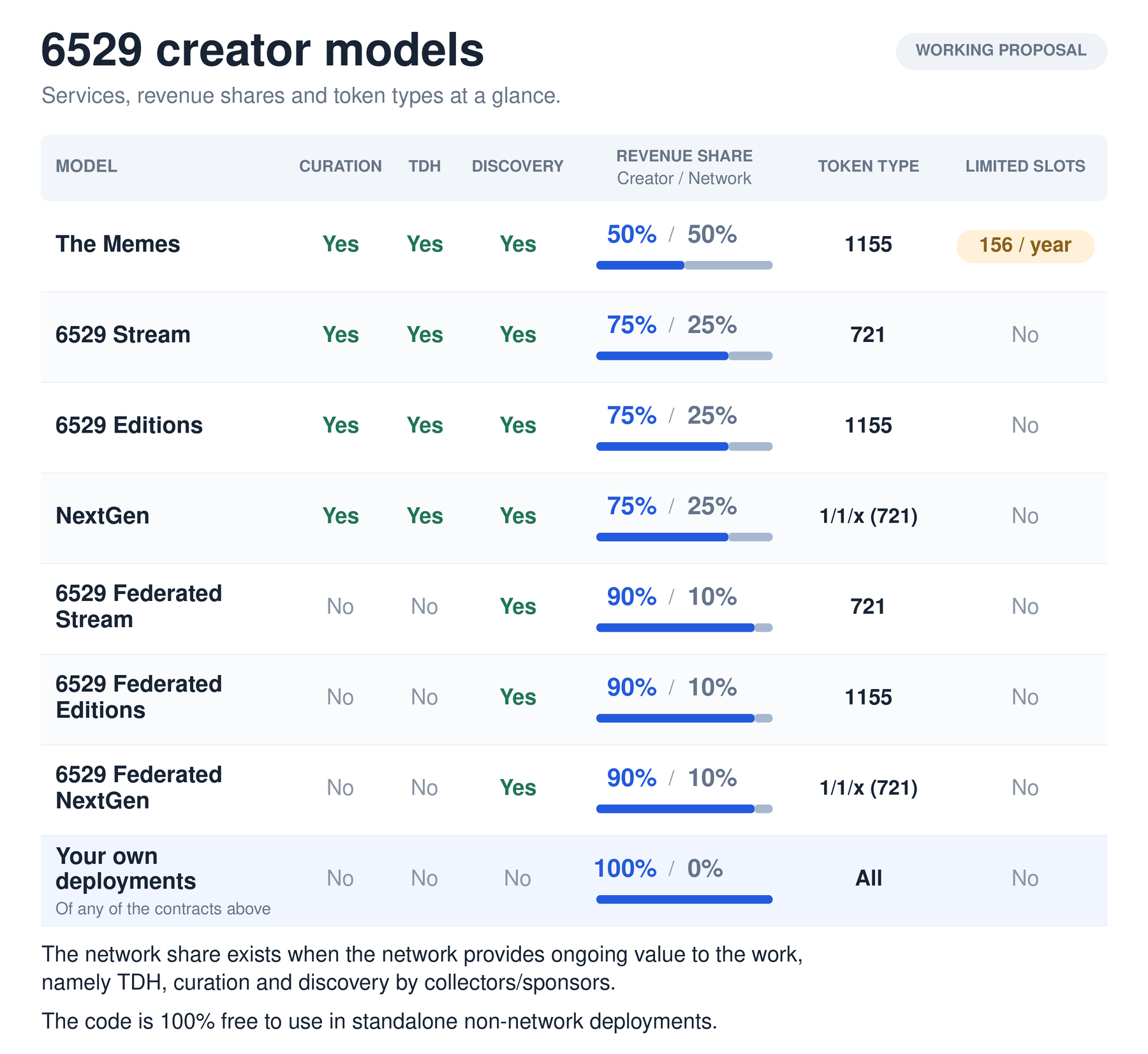
-
The four-wallet update has been tested and deployed. The delegation fix is also live, including all three historical corrections. The cutoff remains **15 October, 00:00 UTC**. **Guided four-wallet signing opens at 00:10 UTC**—please wait until then to register the new links. [Safe Collecting](https://6529.io/safe-collecting) is now live, with the wallet guides and guided consolidation setup described below. https://6529.io/waves/da16201a-f4d0-40cf-b888-9f3a4a86a894?serialNo=1510515
-
**Ministry of Validation (Ministry of Defense)** 1/ We are building unstoppable network organizations 2/ The only way to do this is to run as many independent validators as possible, each person running their own, in every corner of the planet (not just on AWS) so that, whatever is happening on any given day in any part of the world, the blocks are produced, the cards are minted, the votes are counted, the decisions are made, the network keeps working 3/ Everything done so far has been towards this end, to build the moral, psychological, UX and, sure, economic incentives to get people to spent a (small) amount of time and effort to get their own personal validators running . 4/ I expect alpha validators (TDH only, not broader transactions) to be out in November and full transaction processing in Q1 2027 5/ This means we need a team now working on getting the validator network set up. It is time to set up the "Ministry of Validation", which for us is our Ministry of Defense, a global cryptographic shield raised over the network. The Ministry is our validators. We just need to set up a team to help people get it booted up. 6/ This means three jobs: a) Most important and easy: helping our hundreds of maxis get ready, get set up to do this. It is very important that the high TDH identities participate. If you have high TDH, you MUST do this, you must run the software and stay online. We have to have a lot of TDH validating. b) Activate the long tail: There are thousands of less active people that we can aim to reengage for this c) Geographic diversity: This is related to the above but independent also. We need geographic diversity and, if some areas are undercovered, some of us high TDH people may need to help make it happen in those areas. We need local captains, institutions around the world willing to host, willing to participate in this great, wonderful experiment. 7/ We have a shot at greatness here. If hundreds of us validate, we will be among the top 10 chains by number of independent validators on day 1. With thousands, we aim to be #3 behind Bitcoin and Ethereum This should be our goal and we should see it working before we go live. 8/ This needs a team of people working on it (volunteer, PT, FT, located around the world). Start brainstorming who and how will do it. If we need money, we can support this with one or more meme cards 9/ We have 3 - 4 big topics we need to solve this year, but this is the most important one. Without the ability to protect out 'virtual' territory, none of the rest matters. 10/ Think about how we build and staff the Ministry. It is time to test the power of our network. I think we will discover that we live around the world and we can do it, we can get setup around the world., we can coordinate large scale action in the physical world. To be clear, this requires the physical world. a) Computers will need to be switched on in homes and offices running our software. b) In some cases, we should switch on "bare metal" racks in data centers spread across providers and countries to ensure some TDH has high quality connections. c) In some other cases, we can seed some validators deeply off the grid. With PV, batteries and Starlink, we can run a validator anywhere on planet earth. 11/ I repeat, the time is now. Within 2026 we should be able to light up a globe. Wave here: https://6529.io/waves/3c1072f4-4f74-4657-8ad2-c7acf3c9c36d
-
**New: 6529 Suggestion Box.** For ideas that aren’t about the software: community, collections, the Network Museum, events, programs, how things are run. One suggestion per post; react to the ones you support. h/t @[david] for the idea. I also put in top 25 non-dev, non-org identities by level as admins along with dev team, so, enjoy your powerful rights and responsibilities all! No need for things that have no need to be centralized, to be centralized. 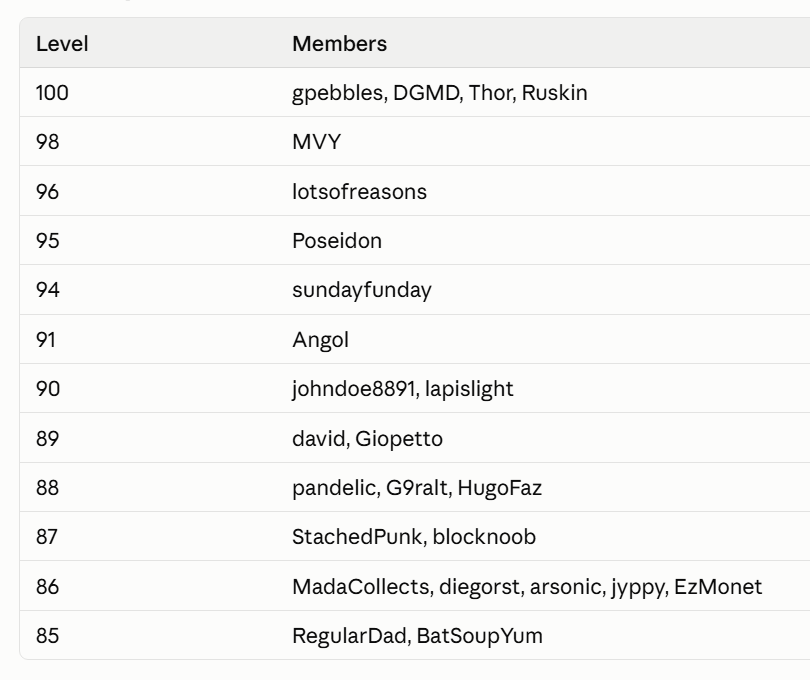 https://6529.io/waves/1853ebd4-d620-42b8-b091-854afd37ed8d
-
**Wave cleanup: where to report bugs, read release notes, and follow the dev team** 1/ 6529 Tech Feedback is a top-level wave again. Post bugs and feature requests there; screenshots help. The dev team will read and reply there. Feedback from the 6529 Stream review page now goes there too. https://6529.io/waves/e933d8d6-0c78-4e8f-aa12-f67d8c11b4dc 2/ 6529 Releases is also top-level again. It used to get a technical note for every deploy. From now on it gets one plain-language summary of each day’s changes, posted at 23:30 UTC, starting tomorrow, plus a post for each desktop and mobile app release. https://6529.io/waves/05b14183-e153-4e47-bc66-42a0f49102d4 3/ Follow The Repo is the dev team’s working chat again, and anyone can read it (e.g. the old Dev Team Chat cc @[simo] @[GelatoGenesis] @[ragne] @[prxt0] (you need to move your bot). Its subwaves are now only automated feeds: Deploys · Production, Deploys · Staging and GitHub PR Feed. Follow those only if you want the raw detail. https://6529.io/waves/49f0e595-ec7c-4235-8695-a527f61b69f4 4/ Dev Team Chat, PR Summaries and Stream Feedback are archived. They’re read-only, and their history is still there. tl;dr: report bugs in Tech Feedback, read what shipped in Releases, and watch the team build in Follow The Repo.
-
gmgm We’ve added two new reply settings for waves: 1/ Open replies lets anyone who can see a wave reply to existing posts, even without chat access. Starting a new top-level post still requires chat access. 2/ Collapsed replies keeps replies grouped under each post instead of appearing in the main chat. You can expand them whenever you want to follow the conversation. Wave admins can enable either setting under About → Configuration → Chat → Replies. Both are now enabled here in Announcements, so anyone can reply to announcement posts, with replies collapsed under each post.
-
-
**Wallet Update 2: 4th address done + Safe Collecting** tl;dr The 4th address for wallet consolidation is built and in review. I now need @[prxt0] @[GelatoGenesis] @[simo] and anyone else interested to go through the 1 issue and 9 linked PRs, test them, deploy them to staging, review them, run the TDH calculations and then deploy and merge. I also did some FE cleanup in ex-Delegation Center. It is better but it is still a bit vibe-coded. So people with great communication skills jump in to help the dev team make it better. We should be PROUD of what we have here but it is very poorly presented (once again, as always, my fault). Dev team top priority to focus on this and test it carefully and ship it. More technical details below: 1/ The rule does not change: every pair of wallets in your consolidation has to link both ways. Only the cap goes from 3 to 4. I checked cheaper rules (e.g. "the new wallet only needs approval from one member") but in all of them one key, or one phished transaction, can pull an outside wallet into your group. So full mesh it is 2/ The 4th slot opens Oct 15, 00:00 UTC. To get to 4, the links have to be registered **after that time**. This is so old, forgotten registrations do not silently create 4-wallet groups. Groups of 2 and 3 are unchanged 3/ It is 4 transactions, not 12. Each wallet signs one batch and the guided setup tells you which wallet signs next. The new wallet signs last so your group never temporarily splits. If your vault has a delegation manager, the manager signs for it and the vault never connects 4/ The TDH calc does not change. Sets, seasons and boosts count across all 4. So if you want to move your vault to a fresh address (e.g. for the reasons in my last post), or you have an old burned/doxxed address, you can keep it combined and keep its TDH 5/ Delegation Center is now "Safe Collecting". It explains the whole system in plain English: - Vault (SAFE or hardware wallet): holds your NFTs, never connects to anything - Transaction wallet (hardware wallet): buying, selling, trading; also the vault's delegation manager - Social wallet (your hot wallet): sign in, vote, post, mint, subscriptions; holds nothing - Old wallet (optional): the 4th slot, for burned/exposed addresses you keep for TDH 6/ If you connect a wallet, it reads your setup and shows what is done and what is missing, with a link to fix each thing 7/ Ideal setup if you are starting fresh: from your SAFE, set your ENS and appoint a delegation manager, then never transact from it again except to move NFTs out. 3 wallets is enough to start 8/ Also rewrote the TAP guide as a proper page, and the TDH consolidation page is now a "Combine your wallets" guide for normal humans, with the technical analysis one click away 9/ Found a bug along the way: delegations signed by a SAFE (and batch delegations) were losing their expiry and token scope in our indexer. Fixed, and we re-index the existing data. Only 3 of 1,640 delegations change. A delegation registered with expiry 0 counts as "never expires", which is clearly what people meant 10/ Status: 9 pull requests (4 backend, 5 front end), all in review, nothing live yet. Plan is backend before Oct 15, then front end 11/ Everything is in the GitHub issue: rules, analysis, dry runs, PRs. Pls poke holes in it: https://github.com/6529-Collections/6529seize-frontend/issues/4214
Loading more drops...